
St. Mary’s VINELink Release Coverage
Maryland VINE is a free, confidential DPSCS service for participating Maryland custody, case, and protective-order information. It is available by web, app, or phone. Notices may arrive by phone, email, text, TTY, or in-app message, depending on the current options. For a former St. Mary’s County detainee, the value is the feeding agency’s event. That source name tells whether the report concerns local jail custody, state correctional custody, or another participating Maryland record.
Coverage has firm boundaries. VINE does not search the Federal Bureau of Prisons, ICE, or the U.S. Marshals Service. A county row disappearing is also not enough to predict a VINE result. The person may have bonded out, completed a local term, transferred to Maryland DOC, entered another custodian’s control, or been affected by a data lag. Search the correct system for the custody type.
Search St. Mary’s VINELink Inmates
Use the Maryland VINELink portal for a specific-person check. Gather the full name, date of birth or age, booking or commitment identifier, and likely custodian first. A correct match depends on more than spelling. Two people can share a name, and a transferred person may appear under a new source or identifier.
- Open Maryland’s page and choose the custody or offender search.
- Enter the person’s name. Add the record identifier when it is known.
- Compare date of birth or age, source agency, location, and identification number before selecting a record.
- Open the plausible match and copy the exact source, status, location, and event or release date shown.
- Cross-check a released or out-of-custody event against court entries, a transfer destination, and post-release supervision when those are relevant.
Do not create a match from a similar name or photograph. If several results remain plausible, return to the booking number or case file. The St. Mary’s released inmate search path shows how to place VINE beside Sheriff, court, state, and federal sources.
St. Mary’s VINELink Release Fields
VINELink fields can vary by feeding agency and event. The Maryland brochure does not promise a permanent archive or the same release field for every former detainee. Read what is actually supplied, and preserve the date of the search. A later blank result should not erase an earlier, properly matched agency event.
| Field | How to read it |
|---|---|
| Name and identifier | Identity anchors; compare them with the booking, commitment, or court record |
| Source agency | The Maryland participant that reported the record or event |
| Status | The source’s current or reported custody description, not a universal custody finding |
| Location | The reported institution or agency, which may change after transfer |
| Event or release date | The supplied date for that source’s change; it may not equal jail gate time |
| Notification options | Channels offered for that matched record |
A released or out-of-custody result means the supplying source reported a change. It does not prove return to the community. A destination record may show transfer to Maryland DOC, another county, BOP, ICE, or supervision. “Released” must be paired with the source and destination whenever possible.
The source image below comes from the official Maryland VINELink search.
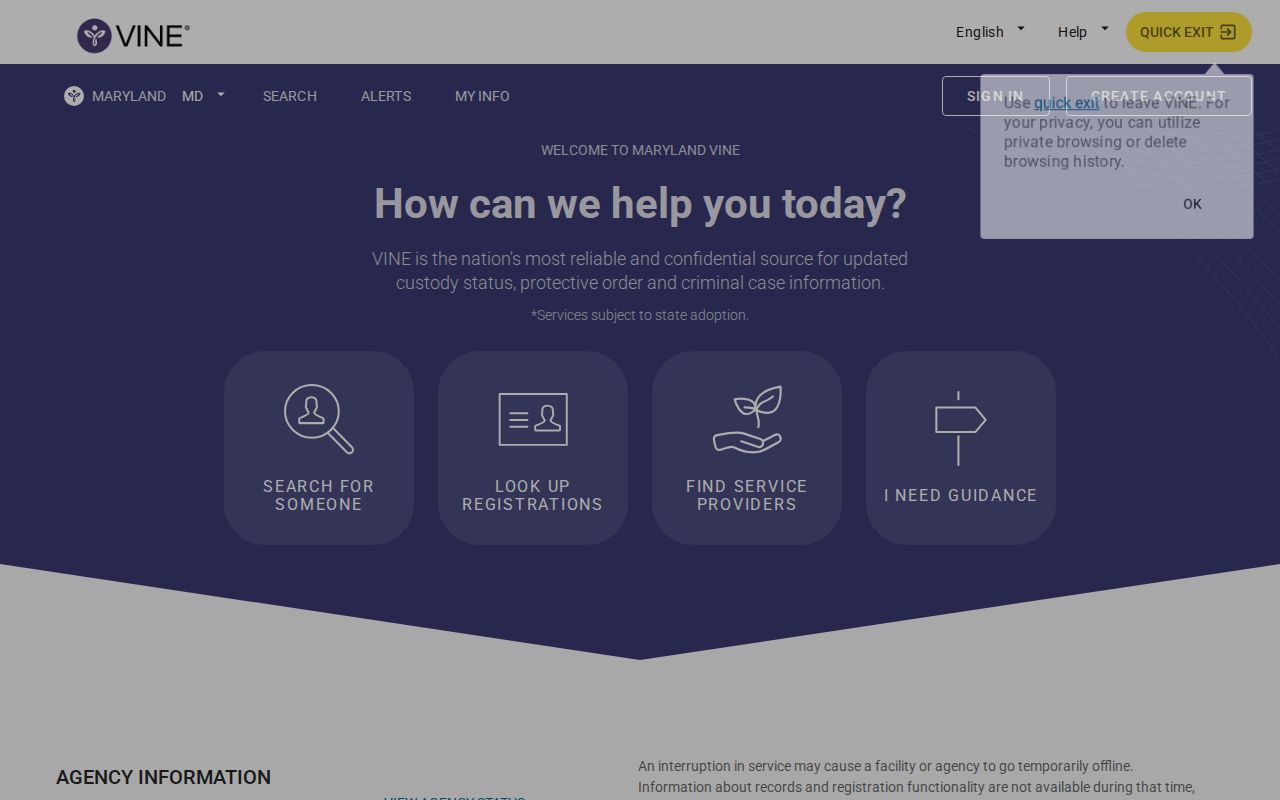
The interface supports a person-focused check, not a countywide recent-release list.
Register St. Mary’s Release Alerts
Registration is strongest while the correctly matched record is open. It lets VINE attach a notification request to that record rather than asking the user to repeat a broad name search. Choose a direct contact route that can receive notices at any hour. The phone PIN acknowledges the automated call; it is not proof of the subject’s identity.
- Open the verified person record and choose notifications.
- Select the delivery method shown, such as phone, email, text, TTY, or app.
- For a phone notice, create a four-digit PIN and keep it available.
- When VINE calls, listen to the event and enter the PIN. This confirms receipt and stops retries for that notice.
- Follow current on-screen confirmation for email or other channels. Email historically did not use the phone PIN.
- Update changed contact details and re-register when a matter moves between courts, custody systems, or supervision if prompted.
The Maryland VINE brochure says unanswered calls are retried for at least 24 hours or until the PIN is entered. Call 1-866-634-8463 and press 0 for a round-the-clock operator to reset or cancel. TTY service is listed at 1-866-847-1298. A direct number is better than a switchboard because an automated notice can otherwise be lost.
Note: Register before the expected release when possible, since a former record may not remain searchable for a uniform period.
Missing St. Mary’s VINELink Results
No result does not establish release. It can reflect spelling, a changed identifier, a data lag, source participation, transfer, retention, or use of a non-Maryland system. Search exact and reasonable name forms, compare the known booking or commitment number, and then move to the custodian that should hold the record.
For current St. Mary’s jail custody, use the Sheriff’s current lookup. For a possible state transfer, the DPSCS locator can establish current qualifying placement, but it deliberately omits people no longer in custody and some others. For the court sequence, Maryland Case Search may show CMIT, BOND, or RELS events. A Sheriff or DPSCS records request can seek the final release sheet, method, and destination. Federal sentenced custody belongs in BOP’s locator; ICE has its own locator; USMS has no public historical release locator.
Each check answers only its own custody question. A person can be missing from both county and state locators during processing or because neither system covers the status. Preserve exact search times and avoid turning absence into a firm conclusion.
St. Mary’s Release Alert Meaning
Maryland documentation lists release, escape, transfer, and probation or parole changes among possible notices, while DPSCS warns that not every institution-to-institution transfer is notified. Event behavior varies. Read the wording on the actual notice instead of assuming that all alerts mean a community release.
A transfer alert may mark the end of one location only. A release alert can still be followed by a detainer, which is a request or order for another agency to take custody, or by parole, probation, or mandatory supervision. A mandatory release is statutory release under written terms, not the end of all sentence control. Court entries can corroborate the legal sequence, but the custodian’s final record best establishes actual method and destination.
- Custody source
- The agency that supplied the VINE record.
- Release event
- A source-reported end or change in that source’s custody.
- Transfer
- Movement to another place or custodian, not necessarily freedom.
- Detainer
- A hold or transfer request from another agency.
- Notification PIN
- The four-digit code that acknowledges a phone alert and stops retries.
St. Mary’s Notification Cross-Checks
Maryland VINE is the local victim-notification layer that reaches participating county and state sources, but it is not the Sheriff’s own release feed. St. Mary’s County publishes a current incarcerated-person lookup with no released tab, release date, or 24-hour and 72-hour history. Its Tip411 app descriptions concern tips, alerts, and agency content, not jail-release notices. Do not substitute that app for VINE.
After an alert, verify identity and source. The Sheriff’s custody categories show why a county disappearance can mean transfer. Check whether a court chronology records RELS or BOND, whether a state or federal receiving system now lists the person, and whether post-release supervision applies. Then seek the final custody record through the county records portal if the exact time, release code, or destination matters. This layered check respects the alert without asking it to prove facts outside VINE’s scope.
A registry match is also different. Maryland’s sex offender registry covers only people who must register by law. It is not a general release list, and absence says nothing about a person outside that statutory group.
Maintain St. Mary’s Release Notices
A notification registration can need attention when the underlying matter changes systems. Maryland’s brochure advises re-registration when a case moves between District and Circuit Court, between local and state custody, or between custody and supervision. The reason is practical: an alert follows a particular participating record, while a transfer can create a new source record. Keep the subject’s identifier and the confirmation details, update a changed phone number or email address, and follow any new prompt shown by the service.
Phone notices continue until they are acknowledged with the four-digit PIN for at least the documented retry period. If the PIN is lost or a notice must be canceled, the toll-free operator can assist. Do not register a central business switchboard or a number that cannot accept an automated call. A private, direct channel makes it more likely that the intended recipient receives and acknowledges the event.
Even a prompt notice is not a safety guarantee or a complete custody report. Verify the source’s wording and use the final agency record for the actual release method and destination in St. Mary’s County. If a matter moves to BOP, ICE, or USMS, Maryland VINE registration does not follow it into those federal systems.
Public Record Search
Sponsored Results