
St. Mary’s County Release Paths
A release ends one specific custody commitment. It does not always mean that the person went home. The St. Mary’s County Sheriff’s Office says its detention population includes people awaiting trial or sentencing, people serving local terms, and people awaiting transfer to the Maryland prison system. Each group leaves the county roster by a different route. A pretrial detainee may post bond or receive a court order. A local-sentence inmate may finish the term after lawful credits. Someone committed to state custody may leave St. Mary’s County only to enter a Maryland Division of Correction facility.
The record must be read narrowly. Bond, recognizance, time served, sentence expiration, parole, mandatory supervision, transfer, and release to a detainer are not interchangeable. A detainer is a request or legal hold from another authority. A person released to that hold has left SMCDRC but has not returned to the community. Escape and death may also remove a name from a current list, which is why roster absence alone proves neither release nor destination.
- Discharge
- The documented end of a particular custody or supervision status.
- Time served
- A sentence resolved by the time already spent in custody.
- Parole
- Conditional community release while a sentence continues.
- Mandatory supervision
- Conditional release when an eligible term less allowed credits is reached.
St. Mary’s County Release Records
A final release record is a corrections record tied to a booking or commitment. It differs from an arrest entry, charging paper, court disposition, or current roster row. The strongest St. Mary’s County release record names the person, the commitment, the facility, and the agency that ended custody. It then states when and how custody ended. A court entry can support that sequence, but the corrections record is the best source for gate time and destination.
The Sheriff’s current Incarcerated Individual Lookup displays ID, name, age, race, sex, booking date, charges, and a mugshot control. It does not display an actual or projected release date, release code, status, destination, archive, or recent-release window. That difference matters. A booking photo can help identify a record, but it cannot prove that a person left custody.
| Field | What it establishes |
|---|---|
| Identity and booking number | Connects the release to the correct person and county commitment. |
| Admission and actual release time | Separates booking, court, bond, and actual departure dates. |
| Release type or code | Shows bond, time served, expiration, parole, transfer, detainer, or another recorded method. |
| Destination or receiving agency | Distinguishes community entry from another jail, prison, federal authority, or ICE. |
| Case and sentence tie-back | Links the custody event to the court authority and listed term. |
| Supervision information | Shows whether parole, probation, or mandatory supervision may follow. |
Note: A release date without its method and destination can still leave the person’s current custody unclear.
Request St. Mary’s County Release Records
The Sheriff routes Maryland Public Information Act requests through its current NextRequest portal. Ask for existing records instead of asking staff to research whether a person was released. Include the full name, date of birth, approximate booking period, and booking ID if known. A narrow request can seek the booking sheet, commitment record, actual release date and time, release or disposition code, the existing code key, and any recorded receiving or detainer agency that may be disclosed.
- Confirm the person’s identifiers and the approximate SMCDRC admission period.
- Open NextRequest or use the Sheriff’s published public-information request form.
- Name each existing record sought, including final custody or release documentation.
- Ask for electronic delivery, segregable portions, and an estimate before costs exceed a chosen limit.
- Compare the produced date, method, and destination with the court and notification trail.
The published Sheriff form says the first two hours of search and preparation are free, then lists $25 per hour, IT work at $37 per hour, a possible $5 photocopy charge through 25 pages, and ten cents per page after that. Those figures are a published schedule, not a quote for a request. Confirm them in the live portal. Under General Provisions § 4-206, reasonable actual costs and the first-two-hours rule apply, while waivers may be considered.
Search St. Mary’s County Releases
The best search begins with the last known custodian. Exact identity comes first. Use full name, date of birth, booking or commitment number, case number, and relevant dates. Similar names and aliases can create a false match. Then preserve the source, search time, and exact words shown. Do not translate “not found” into “released.” A missing result can reflect a spelling issue, system lag, a transfer, legal removal, an omitted class of custody, or another agency.
- Check the Sheriff’s current lookup. A match supports current local listing, subject to the site warning.
- Search Maryland Case Search for each plausible case and compare date of birth.
- Look for CMIT, BOND, and RELS events, while remembering that one case does not rule out another hold.
- Search Maryland VINE and save the exact agency, status, location, and event date shown.
- If state transfer is plausible, use the DPSCS locator. A current match supports transfer, not release.
- Check BOP or ICE only when the case or destination points to federal custody.
- Request the final county or state record when the public trail cannot establish method and destination.
The search path for one named person differs from a recent-release feed. St. Mary’s County has no official rolling public 24-hour or 72-hour release list in the sources reviewed. The Jail Releases: 24 Hours page therefore uses court, VINE, receiving-system, and records-request checks instead of relabeling current detainees.
St. Mary’s County Release Court Events
Maryland’s District Court legend gives unusual value to the code RELS, which means “defendant released from commitment.” CMIT marks commitment. BOND can record a bond event with a date, amount, type, and percentage. Read those entries in order. A matching RELS entry supports release from commitment in that case, but it does not prove the person had no other case, warrant, detainer, or receiving custodian.
Search by exact name first. A partial last name may use at least one starting character followed by a percent sign, and first name is optional with a trailing percent sign available. Narrow by St. Mary’s County, court, date, and case type because searches above 500 results show only the first 500. Match date of birth, then inspect each plausible chronology. Case Search is a summary. Complete records come from the proper clerk through an in-person or written request, not a phone request for a custody determination.
Does a dismissal prove gate time? No. A dismissal, nolle prosequi, or acquittal may explain a legal basis for release, but another hold may remain and the court event may not record physical departure time.
Search Maryland St. Mary’s County Releases
Maryland calls its public tool the Incarcerated Individual Locator. It accepts first and last name and shows placement for qualifying people currently held by the Division of Correction, Patuxent Institution, and some short-sentenced DPSCS facilities. It is not a released-offender archive. DPSCS expressly says people no longer in custody for any reason, including release or escape, do not appear. Some short-sentenced people may also be omitted.
A match after someone leaves SMCDRC can support a transfer to Maryland custody. No match does not establish discharge. The public result lacks released or discharged status, historical release date, supervision office, and projected date. For past state custody, use VINE, court records, parole or probation documents when applicable, and a focused DPSCS Public Information Act request. Ask DPSCS only for state records. The Sheriff remains the custodian of the county segment.
| System | What a result means | What absence means |
|---|---|---|
| Sheriff lookup | Current SMCDRC listing | Bond, completion, transfer, lag, escape, mismatch, or another custodian |
| DPSCS locator | Current qualifying Maryland placement | Release, escape, omission, or no state commitment |
| Maryland VINE | Participating source’s reported status or event | Mismatch, lag, retention, participation, or another source |
| Final release record | Actual date, method, and destination when recorded | Request may need narrowing, correction, or the proper custodian |
The official locator’s limitation is visible in the DPSCS source page.
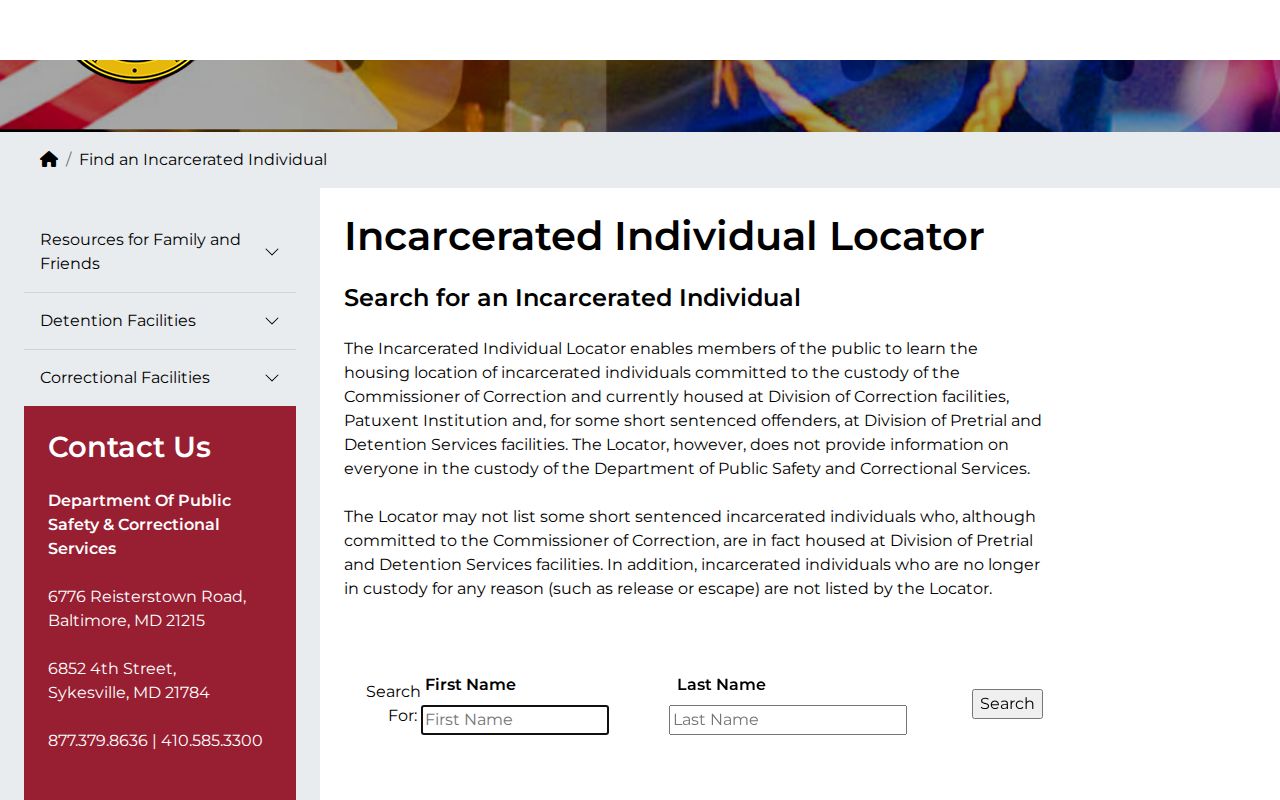
The captured interface supports current state placement checks, not a historic St. Mary’s County release finding.
St. Mary’s County Release Statistics Limits
Official 2024 figures describe correctional populations, not releases. The county statement reports an incarcerated range of 197 to 232 and a rated capacity of 321. The Sheriff report gives adult average daily population of 216.08, split into 184.33 male and 31.75 female, plus a 4.91 average for juveniles charged as adults. None of these figures counts admissions, discharges, unique people, or annual turnover.
Community Corrections measures must remain separate. The county statement reports 68 to 91 people in pretrial programming and 19 to 35 in day reporting or home detention. The Sheriff report gives monthly averages of 81 and 25. A high-minus-low calculation is not a release count, and daily population multiplied by days is not a count of distinct people. These measures show why correctional control extends beyond the jail walls.
St. Mary’s County Monitored Releases
The St. Mary’s County Community Corrections Center manages Pre-Trial Supervision, Day Reporting, and Inpatient Treatment. A participant may live outside SMCDRC while still following judge-set restrictions, electronic or in-person monitoring, testing, and case management. A violation can lead to remand, which means return to custody by legal order. No public participant lookup was found.
This local structure makes “not in jail” an incomplete status. A person may have bonded out and entered pretrial supervision rather than receiving an unconditional discharge. The court order and Community Corrections terms explain the control that follows. The final SMCDRC record can establish the county custody exit, while the court record may show bond and conditions. Neither should be stretched to claim the other.
Note: Community Corrections is a monitored alternatives operation, not a public archive of St. Mary’s County released inmates.
St. Mary’s County Release Reentry Services
SMCDRC’s incarcerated individual services describe case managers, a licensed social worker, peer specialists, and individual aftercare planning. The jail began a medication for opioid use disorder program in September 2020. Assessed medications may include methadone, buprenorphine, or Vivitrol, with continuity and referral planning.
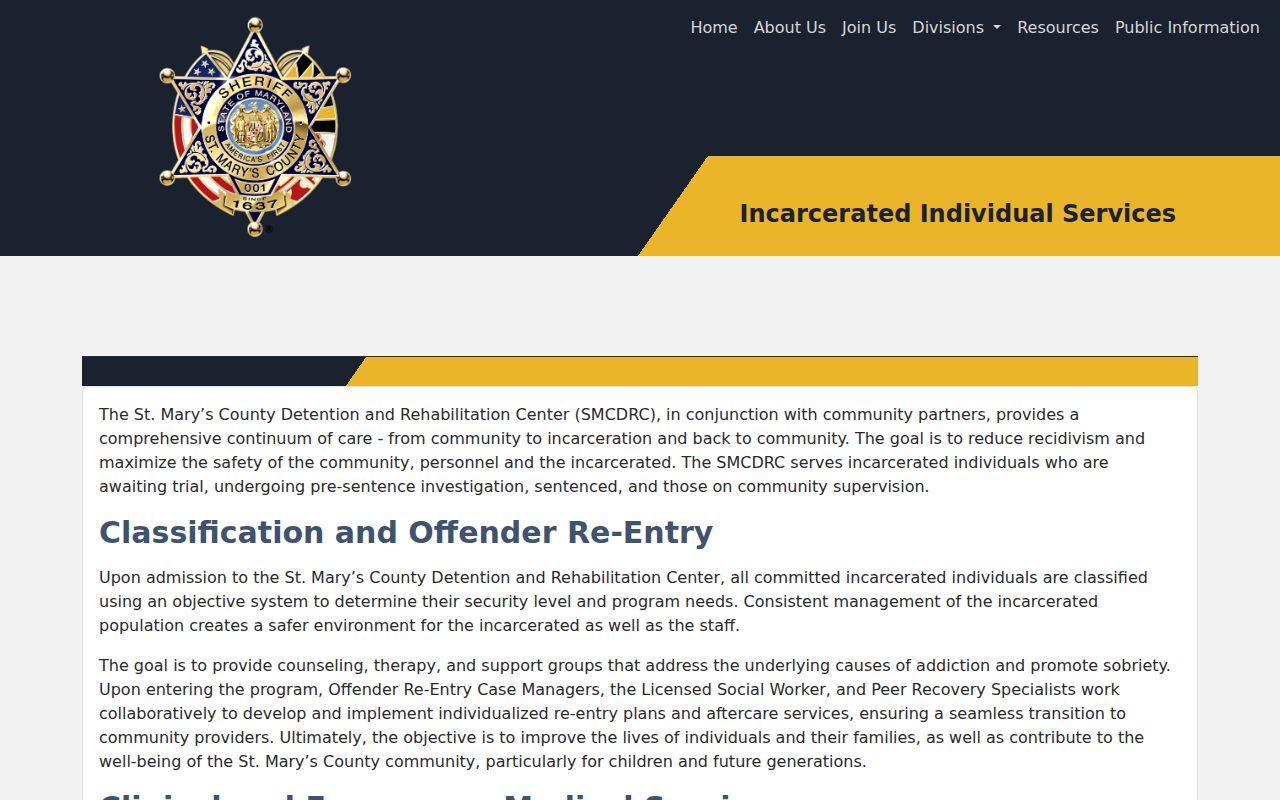
The local source supports a transition path from custody toward community care. It does not promise that every released person receives each service, remains eligible after departure, or will be accepted by a particular provider. Ask the facility or case manager about the person’s documented plan before relying on a referral.
Getting Home After St. Mary’s County Release
St. Mary’s Transit names the Leonardtown Governmental Center Complex as a transfer point and provides dispatcher help through the county line at extensions *1120 and *1121. No official source confirms a jail-gate stop, a release exit, a family waiting area, or a jail-provided ride. A person arranging transport should verify the nearest stop, transfer, time, and current fare with the dispatcher.
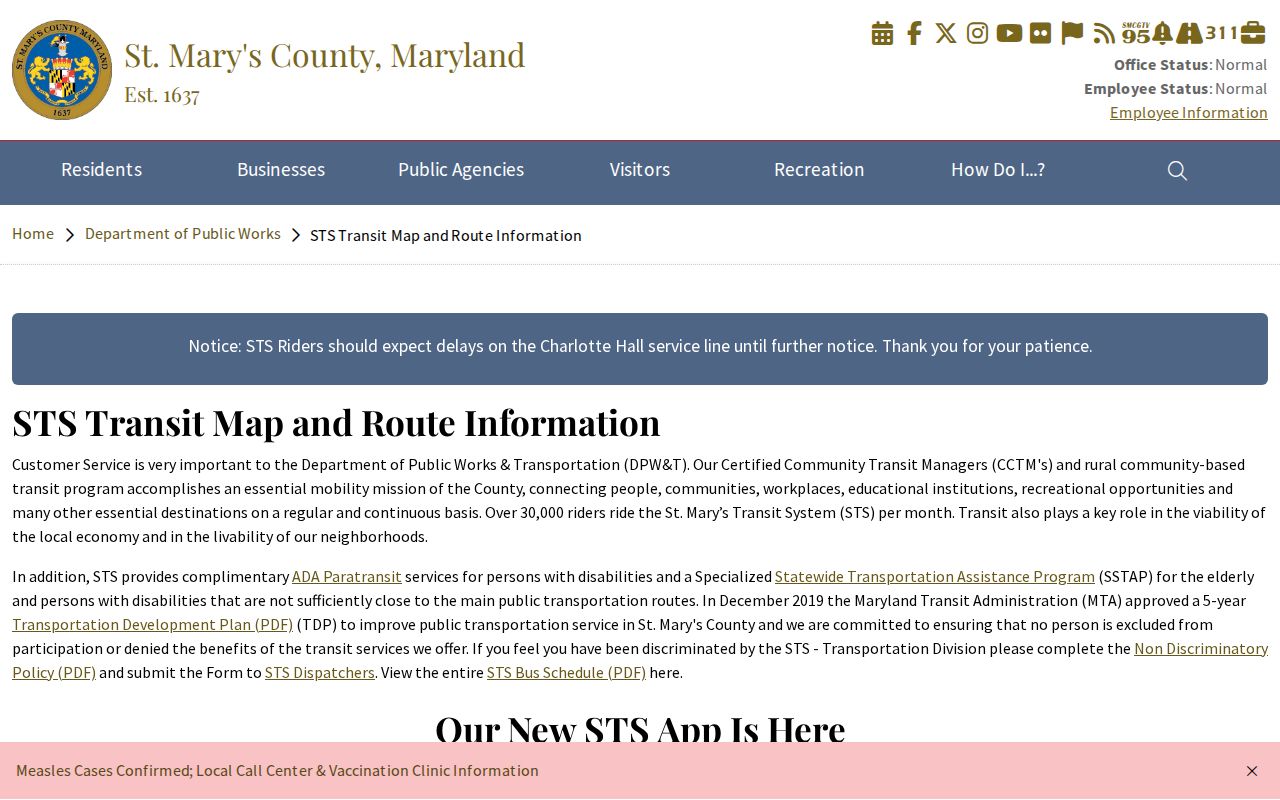
The transit source says a stop request should be made at least 20 minutes ahead. That rule does not create a confirmed pickup at SMCDRC. Release timing also has no fixed public schedule in the reviewed material, so transport plans should remain flexible until the facility confirms that processing is complete.
Property After St. Mary’s County Release
The Sheriff’s evidence and safekeeping property return process is appointment-based. The property unit uses SMCSOProperty@stmaryscountymd.gov and the county phone line at extension 2238, with stated weekday hours from 8 a.m. to 4 p.m. The published process may require identification, related papers, and a notarized letter when a third party retrieves property.
That policy is not expressly described as the routine discharge-property process for every person leaving SMCDRC. Do not assume all personal items follow it. Ask the detention center which property was held with the person, which was booked as evidence or safekeeping, and which office controls its return. This distinction can prevent a trip to the wrong counter.
St. Mary’s County Release and Expungement
Physical release and legal completion of sentence can occur years apart. Maryland Criminal Procedure § 10-101 defines sentence completion for expungement purposes to include the expiration of probation, parole, and mandatory supervision. A person may therefore be outside SMCDRC while the waiting clock tied to full sentence completion has not begun.
Case Search records may remain for a long period unless access changes by law or court order. Expungement removes qualifying court and law-enforcement information. Shielding limits public access to eligible material but does not destroy it. Preserve any order because later public copies may be unavailable. A missing court result may reflect lawful removal, remote-access limits, or a protected record, not proof that no case existed.
Note: Release from custody alone does not create a universal Maryland expungement date or guarantee removal from public systems.
St. Mary’s County Release Facility Expansion
The SMCDRC expansion has two distinct dates. A June 2021 ribbon cutting marked new clinic and infirmary space, female living units, and rehabilitation program space. The county later reported that the multi-phase expansion and renovation was completed in January 2023. Both facts can be true because they describe different points in a staged project.
The added clinical and program space gives context to the Sheriff’s reentry and medication-continuity work. It does not establish a release count, a set release hour, or a promise of services for each person. Facility history should help identify the operation and its role, not be used to infer the status of someone whose name left the roster.
St. Mary’s County Release Facility Routes
Five facility or custody systems form the local decision map. They are not five jails in St. Mary’s County. SMCDRC is the county detention facility. Community Corrections is a monitored alternatives operation. Maryland DOC facilities may receive state commitments. BOP covers federal sentenced custody, while ICE and the U.S. Marshals handle separate immigration or federal pretrial and transport contexts.
| Facility or system | Where the release trail continues |
|---|---|
| St. Mary’s County Detention and Rehabilitation Center | County final record, court/VINE, community, Community Corrections, or receiving custodian |
| St. Mary’s County Community Corrections Center | Court order and program records; no public participant lookup found |
| Maryland Division of Correction facilities serving commitments from St. Mary’s | Current DPSCS locator, VINE, court, supervision records, or DPSCS request |
| Federal Bureau of Prisons | BOP Locator may retain a federal release date and status |
| ICE / U.S. Marshals custody | ICE locator or case-specific federal contacts; USMS has no historic public release locator |
A BOP result marked “Not in BOP Custody” speaks only to BOP custody. An ICE no-result is also inconclusive. When a sending record says release to a detainer, check the named receiving agency before describing community entry.
Public Record Search
Sponsored Results