
Federal Prison Release Scope
The Federal Bureau of Prisons holds people serving federal sentences. No BOP prison was identified in St. Mary’s County, so this Facility Map entry represents a federal system that may matter because of a federal case, sentence, or detainer. It is not a local building and has no St. Mary’s release desk. A person once held at SMCDRC is not automatically in BOP records.
BOP’s public locator covers federal sentenced custody from 1982 forward. That makes it different from Maryland’s current-only locator. Some former federal prisoners remain searchable with a release date or a status such as “Released” or “Not in BOP Custody.” Yet neither phrase means the person has no state, county, immigration, or supervision status.
Search Federal Prison Releases
Use the official BOP Inmate Locator. An identification-number search is more precise than a name search. BOP accepts Register, DCDC, FBI, or INS numbers. Its name search can also use age, race, and sex as optional descriptors. Compare every returned field before selecting a person.
- Gather full legal name, known aliases, date of birth or age, and any federal identification number.
- Search by Register or another accepted number when available. Otherwise search the name and narrow with descriptors.
- Compare the register number, age, race, and sex. Do not rely on name alone.
- Read the exact location or status and the displayed release date.
- Check the federal case for sentence context, then seek the official release or arrival record if destination matters.
- Search state, county, or ICE custody separately when a transfer or detainer is plausible.
The St. Mary’s County release-record search helps identify whether the county, Maryland DOC, BOP, ICE, or another agency is the correct custodian.
Federal Release Result Fields
A BOP result is a compact identity and custody record. It should be copied with the search date because federal calculations can change. First Step Act recalculation is one documented reason a date may move. A locator result is useful, but a detailed release record can answer questions the public row does not.
| BOP field | What it shows |
|---|---|
| Name | The identity used by BOP for the result |
| Register number | The main federal custody identifier |
| Age, race, and sex | Comparison fields that help prevent a wrong match |
| Release date | The date supplied in BOP’s record, subject to its status and updates |
| Location or status | Current institution or a released/not-in-BOP-custody description |
The official BOP locator appears in the source image below.
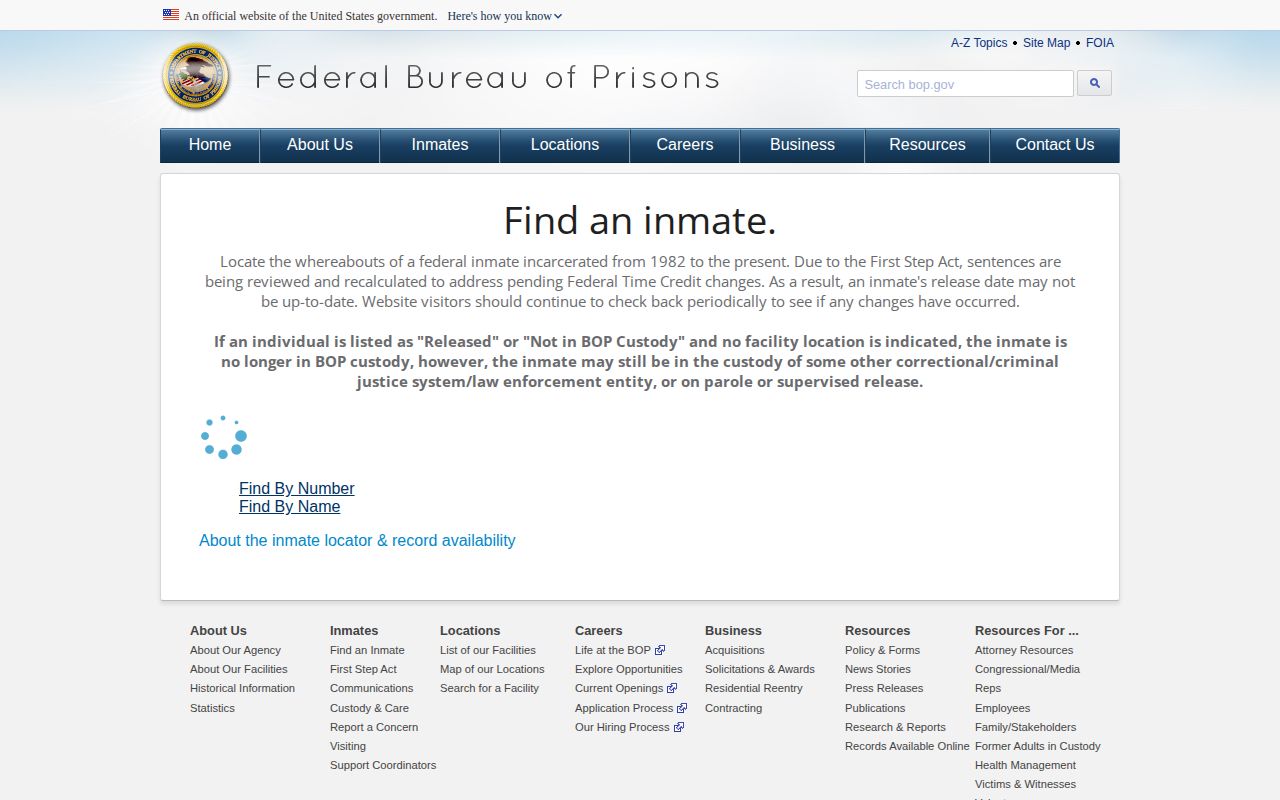
Its federal identifiers and status fields should be matched before any release inference is made.
Note: A BOP release date does not establish that county, state, immigration, or supervision control also ended.
Federal Release Destinations
BOP’s blank Notice of Release and Arrival form illustrates the detail needed after a locator result. It contains the release method and date, a community or detainer destination, the detaining agency, transportation, supervision jurisdiction, and reporting instructions. Those fields show why “released” is not always “home.”
A person may begin federal supervised release in the community. Supervised release is a court-ordered federal status after imprisonment, not parole and not an unconditional end to the case. Another person may be transferred to a state sentence or to immigration custody. BOP release statistics exclude some transfers to state sentence, treaty transfer, or ICE, so public counts should not be used to infer an individual path.
The official BOP Notice of Release and Arrival form is a useful field guide. A completed form or comparable agency record, when lawfully available, is stronger destination evidence than the locator row alone.
Federal Pretrial Release Records
The U.S. Marshals Service manages federal pretrial prisoners and transport. It can use local or contract beds, but no local federal detention facility or contract was found in St. Mary’s official-source research. USMS has no historical public release locator. A missing BOP result therefore does not prove federal release because a pretrial person may never have entered BOP sentenced custody.
Use the federal docket, authorized case contacts, the holding facility, or the District of Maryland Marshals office for the federal pretrial segment. After a federal sentence and designation, BOP becomes the relevant public locator. The USMS prisoner program describes its detention and transport role but does not provide a name-based historical release search.
A transfer from SMCDRC to a marshal ends the county segment. The county final record should identify the receiving agency when recorded and disclosable. It does not establish later BOP release.
Federal Immigration Release Boundary
ICE uses the Online Detainee Locator System. Search can use an A-number with country of birth or exact biographical details. It is separate from BOP and is not a St. Mary’s archive. A no-result can reflect mismatch, processing, transfer, scope, age, older release, or another agency.
No official accessible source confirmed a fixed post-release visibility period, so no number should be promised. An ICE release can also involve ongoing proceedings or supervision. Likewise, a BOP release-to-ICE record means federal prison custody ended while immigration custody began. Read both sources and the destination field.
Maryland VINE does not cover BOP, ICE, or USMS. A VINE no-result has no bearing on those federal systems.
Request Federal Release Records
A useful request names the exact federal record and custody period. Provide the full name, date of birth, register number, institution, and approximate release date. Ask for an existing release notification or release-and-arrival record, the method and date, destination type, detaining agency when applicable, transport information, and supervision jurisdiction, subject to lawful access and redaction.
Do not send a federal request to the St. Mary’s Sheriff or DPSCS. Those agencies can answer only for their own custody segments. The Sheriff’s final record may document a transfer to USMS, while DPSCS may document a transfer from Maryland custody. BOP holds BOP sentenced-custody records. The court holds the federal docket and judgment.
- Register number
- BOP’s identifying number for a federal custody record.
- Not in BOP Custody
- A status that rules out BOP custody, not every other custody.
- Detainer
- A request or order for transfer or continued custody by another agency.
- Supervised release
- Court-ordered federal community supervision after prison.
Verify Federal Prison Release
The strongest verification joins identity, custodian, method, destination, and date. First match the BOP row. Then read the federal judgment and any later docket order for legal context. Obtain the release record when the destination matters. Finally check the named receiving system rather than assuming that no BOP custody means community release.
A state or county detainer can produce a valid BOP release date and a valid state or county custody record on the same person. ICE custody can do the same. Gaps may occur during transport. Preserve the exact wording and search time from each source so that a later update does not blur the sequence.
For a prior St. Mary’s stay, the current county lookup identifies only present local custody, and the Sheriff’s custody categories show why transfer must remain a live possibility. Request the final county record through NextRequest to learn when and why the local segment ended. The BOP record answers the federal sentenced segment. Neither can substitute for the other.
Federal Release Date Changes
A displayed BOP date is not immune from revision. The research identifies First Step Act recalculation as one reason a federal date can change. A later court order, sentence correction, restored or lost credit, or a status update can also alter the record when supported by the federal file. Record the locator date and the day it was viewed. If two official versions differ, ask BOP which calculation now controls rather than choosing the more convenient date.
Projected departure and actual release remain separate. The locator may supply the public release date, while the release-and-arrival record can add method, destination, detaining agency, travel, and reporting directions. Those fields matter most when family or counsel must distinguish community arrival from transfer. A detainer can produce a completed BOP release event without a period outside custody.
Federal supervised release also has its own end date and conditions. It should not be labeled BOP custody once the person leaves prison, yet it can remain a court-controlled status. Use the federal judgment and supervising court records for that phase.
Public Record Search
Sponsored Results