
Maryland DOC Release Paths
The Facility Map entry describes a statewide correctional system, not one prison in St. Mary’s County. No Maryland state prison was identified within the county. People sentenced from St. Mary’s can first be held at the Detention and Rehabilitation Center while awaiting transfer, then enter a DPSCS institution selected by the state. The county roster may drop the person during that move.
A state-prison exit can lead to the community on parole or mandatory supervision, to sentence expiration, or to another custodian on a detainer. Parole is conditional release granted by the Maryland Parole Commission while the sentence continues. Mandatory supervision is release under statutory conditions after applicable credits. A detainer can send the person straight to another agency. The final state release record should identify the actual date, method, and destination.
Confirm Maryland DOC Releases
Start with the Maryland Incarcerated Individual Locator. Enter first and last name and compare the returned housing location with the person’s commitment details. A match establishes current qualifying DPSCS custody. It does not prove where the person was held on an earlier date and does not provide a future date.
- Confirm full name, date of birth, SID or DOC number, St. Mary’s case number, and likely commitment dates.
- Search the DPSCS locator. Record the exact name, location, and search date if a matching current result appears.
- If no match appears, check Maryland VINE for a source-reported custody change and Maryland Case Search for the sentence and later orders.
- For possible parole or mandatory supervision, consult the matching MPC or DPP record. Maryland has no public DPP name search.
- Request the existing DPSCS discharge record, date, method, destination, and applicable calculation records through the state PIA channel.
The St. Mary’s County release search is useful when the original custodian remains uncertain. It separates county, state, and federal systems before a conclusion is drawn.
Missing Maryland DOC Release Results
DPSCS states that people no longer in custody for any reason, such as release or escape, are not listed. It may also omit some people serving short sentences. A no-result therefore has several meanings and never proves discharge. The locator has no “Released,” “Discharged,” historical date, supervision office, or projected-release field.
This is a deliberate system limit, not a broken search. A person committed only to St. Mary’s County jail is not expected in the state locator. A person moving from county to state custody may also be absent during processing. Check the receiving record, VINE event, court case, and the final county transfer destination rather than filling the gap with an assumption.
The official DPSCS limitation page appears below.
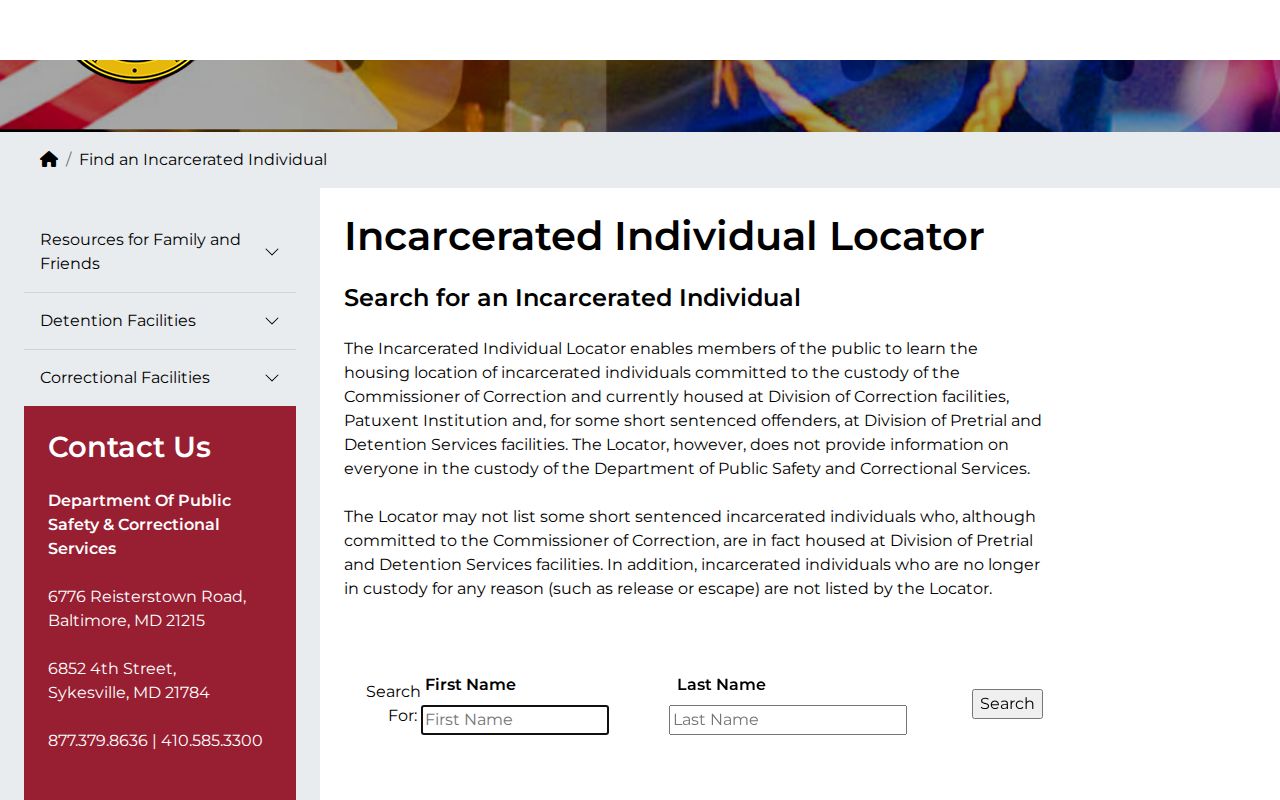
Its current-only language explains why past discharge must be found through another record channel.
Note: A missing state result can mean release, escape, omission, processing, or lack of any state commitment.
Maryland DOC Discharge Records
For current custody verification, the Division of Correction FAQ directs questions to Data Processing. Staff can use full name, date of birth, race, sex, and Social Security number if known to confirm custody, a commitment number, and mailing address. The listed numbers are 410-585-3350, 410-585-3351, and 410-585-3352. That service is not discharge proof and does not promise a release-date calculation.
Past custody belongs in a focused DPSCS Public Information Act request. Identify the person, date of birth, SID or DOC number, facilities, and date range. Ask for existing final discharge or release records, the actual date and method, the destination or receiving agency when recorded and disclosable, and the calculation or credit ledger as a separate target. DPSCS holds state records, not the Sheriff’s county detention file or the Judiciary’s case file.
DPSCS Public Information Act
PIA Coordinator
6776 Reisterstown Road, Suite 212
Baltimore, MD 21215
dpscs.pia@maryland.gov
Main line: 410-585-3300 or 877-379-8636
Maryland law permits exemptions, redaction, and actual costs. Ask for segregable portions rather than assuming that every field will be produced.
Read Maryland DOC Release Records
A sound state discharge record begins with identity and the state commitment number. It should then identify the institution, admission or commitment authority, actual release date, release method, and destination. Parole, mandatory supervision, sentence expiration, and release to detainer have different effects. An internal code should be read with the agency’s existing code key, not guessed.
| Record field | What it resolves |
|---|---|
| Name, DOB, SID or DOC number | Whether the record concerns the correct person |
| Facility and commitment | The specific state custody that ended |
| Actual date and time | When the recorded DOC event occurred |
| Method or code | Parole, mandatory release, expiration, transfer, or other event |
| Destination | Community, supervision, receiving jail, federal agency, or immigration custody |
| Update date | When the record was entered or revised |
Read source, method, destination, and date together. “Released by Maryland DOC” is narrower than “returned to St. Mary’s County.” Another jurisdiction may hold the person, and a supervision term can continue after prison departure.
Maryland DOC Post-Release Control
The Maryland Parole Commission decides parole suitability. DPP supervises parole, probation, and mandatory release. MPC approval can precede departure because an approved home plan, program, or other requirement may still be pending. Misconduct can suspend approval. A hearing result must not replace the final release sheet.
After physical release, a person may remain under written conditions. Maryland provides no public person-by-person DPP lookup, so use the court order, a legitimate official notice, VINE when the event is supplied, and a targeted procedural contact. The Leonardtown DPP office is at 23110 Leonard Hall Drive and can route supervision questions, though no public disclosure of a named person is promised.
Discharge comes later when the relevant sentence and supervision end. DPSCS may issue a certificate of completion under Correctional Services § 7-103 when the statutory conditions have been met, but issuance is not automatic.
Maryland DOC Projected Date Limits
The public locator’s lack of a projected field is distinctive and consequential. A pronounced sentence can be altered in calculation by presentence credit, concurrent or consecutive terms, offense date and class, diminution credits, revocation or restoration, parole action, later court orders, escape time, and detainers. No outside calculator has the complete ledger.
Maryland also has no blanket 85 percent rule for all sentences. It uses offense-specific parole thresholds and credit provisions. Ask DPSCS whether a cited date is tentative, mandatory-supervision, maximum-expiration, parole-eligibility, or actually scheduled. The St. Mary’s projected release record page explains those date types and the official record targets.
Even an accurate projected date cannot establish destination. Register with VINE for a reported event and obtain the final discharge record afterward.
Maryland DOC Facility Scope
This Facility Map entry represents all Maryland DOC facilities that may serve commitments from St. Mary’s, not a named local prison. No local state institution was found in the official-source sweep. Classification and placement belong to DPSCS. The county Sheriff’s role ends at the county segment unless its own record documents a later transfer.
The practical flow is: St. Mary’s arrest and county detention, court commitment, possible wait for state transfer, DPSCS placement, and then parole, mandatory release, expiration, or another transfer. Every arrow creates a separate record. A gap between the county and state locators can reflect transport or processing. It should never be converted into a claim that the person is free.
St. Mary’s State Transfer Proof
The Sheriff’s Corrections Operations page expressly identifies people at SMCDRC who are awaiting transfer to Maryland’s state-prison system. That local fact makes transfer a primary explanation for roster disappearance, not a remote exception. Preserve the county booking identifier, search time, and case number from the current county lookup. Then compare the Sheriff’s destination field or VINE transfer event with the first matching DPSCS placement. The state appearance supports receipt by the new custodian.
A processing gap can leave the person absent from both public locators for a time. The gap is not a release record. Ask for the final county custody sheet and receiving agency through the Sheriff’s records portal, then use DOC Data Processing for current state placement. The county sheet proves the end of the local segment; the state record proves the next segment. Only a state discharge record with method and destination can establish the later DOC exit.
Public Record Search
Sponsored Results