
St. Mary’s Parole Versus Probation
The Maryland Parole Commission, or MPC, decides whether an eligible person may leave a correctional facility on parole. Parole is a discretionary and conditional release while the sentence continues. The Division of Parole and Probation, or DPP, then supervises parole in the community. Probation is imposed by a court, often with a suspended sentence or after a term in custody. DPP also supervises that court status. Mandatory supervision is different again. It begins when an eligible prison term, less allowed diminution credits, reaches the statutory release point. Conditions still apply.
These labels describe legal control, not just location. A person on parole, probation, or mandatory supervision may live outside a jail or prison and still have reporting duties. A violation can result in a warrant, revocation, and return to custody. Unconditional discharge comes later, when the controlling order or sentence and all supervision have ended.
| Status | Who starts it | What it means |
|---|---|---|
| Parole | Maryland Parole Commission | Conditional release while a sentence continues |
| Probation | Maryland court | Court-ordered community supervision |
| Mandatory supervision | Statutory release process | Release after applicable credits, under written conditions |
| Discharge | Controlling agency or court | The relevant custody or supervision term has ended |
Verify St. Mary’s Post-Release Supervision
There is no Maryland public DPP search that accepts a person’s name and returns a supervision status. A careful check uses documents from the agency that created the status. Begin with identity and the correct case. Similar names are common, and one person can have several cases or custody sources. Never treat absence from the county jail roster as proof that supervision began or ended.
- Search the matching case in Maryland Case Search. Compare the full name, date of birth, case number, disposition, sentence, and probation terms.
- Check Maryland VINE for the participating source’s reported custody or supervision event. A no-result remains inconclusive.
- For a possible parole decision, use a legitimate MPC notice or contact the Maryland Parole Commission about its process. Approval is not the same as release.
- Use the DPP office directory to identify the Leonardtown office. Ask what records or procedure may confirm the status, while expecting privacy limits.
- Seek the actual release or discharge record from the Sheriff for county custody or from DPSCS for a state commitment. Read the method, date, destination, and supervision terms together.
For the full custodian-first route, the St. Mary’s County released inmate search explains how county, state, court, VINE, and federal records fit together.
St. Mary’s Supervision Office Records
The Leonardtown DPP field office is a local reporting and navigation point. It is not a promised public verification line, and staff may be unable to discuss a named person. The strongest documentary targets are the court order, a formal supervision record that may be disclosed, the release order, and a certificate showing completion when one has been issued. A phone statement should not replace those records.
Division of Parole and Probation
Leonardtown Field Office
Joseph D. Carter Building
23110 Leonard Hall Drive
P.O. Box 1509
Leonardtown, MD 20650
301-880-2750 or 866-381-1178
Fax: 301-475-5238
Correctional Services § 7-103 permits DPSCS to issue a certificate of completion to a formerly supervised person who completed all conditions, including required restitution, fines, and fees, and is no longer under Department jurisdiction. The statute says the Department may issue it, so the certificate is not automatic. It can be more useful than trying to infer completion from an empty online search.
Note: The Leonardtown office can explain procedure, but no source promises public confirmation of a named person’s active supervision.
St. Mary’s Parole Decision Stages
MPC makes parole decisions for eligible Maryland sentences, including some people serving qualifying county sentences. Its published terms must be read precisely. “Refuse” means no more parole hearings. “Rehear” sets another hearing for a stated future time. “Approve” means release may occur after required pre-release steps are met. None is an actual jail or prison exit record.
An approval can be followed by a substantial delay. MPC explains that an approved home plan or program may be required. Misconduct or failure to meet a condition may suspend the approval. The reliable sequence is eligibility, hearing, outcome, completion of prerequisites, and then an actual custody event. The MPC FAQ describes these outcomes and the reason the final event must be checked later.
The Commission’s public meetings every other Wednesday are not individual parole hearings. A directly available Open Parole Hearings list from 2024 shows the prior format, including date, time, location, name, and DOC or Criminal Law number, but it is stale evidence rather than a current calendar. Call MPC at 410-585-3200 for the current process. As of the research date, a 2026 Maryland law expanding decision publication did not take effect until October 1, 2026.
Note: An MPC approval supports a future release path, while the later custody record establishes whether and when departure occurred.
St. Mary’s Supervision End Dates
Active reporting can end before the legal supervision term expires. Under Correctional Services § 6-117, earned compliance credits can reduce active supervision or home detention by 20 days for a compliant month under the statute. When time served plus credits satisfies the active portion, DPP places the person on abatement. Abatement means active supervision has been reduced or paused under the statutory process. It is not final expiration of the sentence.
DPP supplies a tentative transfer-to-abatement date. “Tentative” matters because compliance, court action, or another legal event may change the record. Final discharge should be confirmed through the controlling order or official completion document. Presentence reports are not a public substitute. They are confidential without a court order under Correctional Services § 6-112.
- Absconder
- A person alleged to have stopped reporting or left supervision without authorization.
- Revocation
- An official decision withdrawing conditional release or probation after the required process.
- Abatement
- A reduced active-supervision stage that can begin before legal expiration.
- Certificate of completion
- A document DPSCS may issue after all qualifying conditions and Department control have ended.
St. Mary’s Warrants and Violations
DPP describes a Warrant Apprehension Unit, but the researched state and county sources did not reveal a public absconder list. Do not infer a warrant from a missed appointment, a VINE result, or the absence of a supervision name search. A violation allegation, warrant, hearing, and revocation are separate stages. The matching court docket or an authorized agency record is the proper source.
A new hold can also change the apparent release path. Someone may leave one institution on parole or mandatory supervision yet be delivered to another agency on a detainer. A detainer is a request or order for a custodian to hold or transfer the person for another case or agency. Read the release destination and receiving agency before describing the person as back in the community. A VINE alert reports the participating source’s change, not the absence of every other warrant or hold.
Conditions vary with the governing order. High-level examples can include reporting, approved residence, program participation, and compliance with the law, but only the person’s written order controls. For a specific question, obtain the order instead of assuming standard terms.
County confinement does not rule out a parole case. MPC states that eligible people serving six months or more in state or local facilities can fall within its work, and qualifying county-sentence hearings may occur at the detention center. Eligibility is only the point at which consideration may begin. It does not establish a favorable outcome, the completion of pre-release steps, or an actual departure from St. Mary’s custody. Match the hearing material to the final custody record.
St. Mary’s Release Reentry Support
St. Mary’s County’s release landscape includes services inside the Detention and Rehabilitation Center. The Sheriff documents case managers, a licensed social worker, peer specialists, individualized transition planning, and referrals. Its medication program for opioid use disorder began in September 2020 and can involve assessed use of methadone, buprenorphine, or Vivitrol with continuity planning.
The Sheriff’s incarcerated individual services page describes that local work. The source does not promise that every released person receives every service or that an outside provider will accept a referral. The program record is also not proof of probation or parole. It explains one bridge from custody to community care, while DPP and MPC records answer the supervision question. The Sheriff’s Community Corrections description identifies monitored local programs but offers no public participant lookup. The current detention lookup likewise answers present jail custody, not supervision after release.
The source view below shows the official local transition-services page.
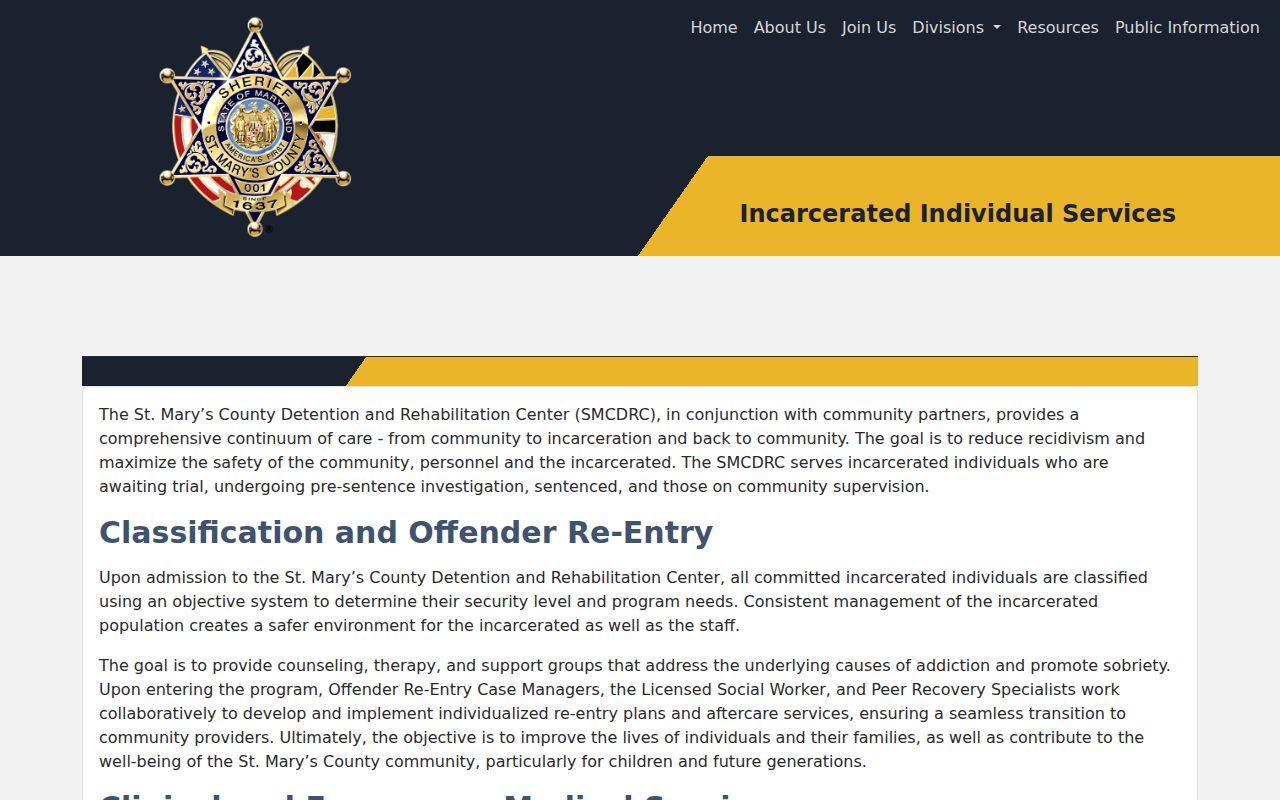
Its program detail supports careful questions about continuity after release, without turning a general service description into a promise for one person.
Public Record Search
Sponsored Results