
Community Corrections Release Status
The St. Mary’s County Sheriff’s Office Community Corrections operation manages Pre-Trial Supervision, Day Reporting, and Inpatient Treatment. Its work can include electronic monitoring, in-person reporting, testing, and case management. A participant may be outside the St. Mary’s County Detention and Rehabilitation Center yet remain under county and court control. Physical presence in the community does not equal unconditional discharge.
Pretrial conditions come from a judge. The court order can set restrictions while the criminal case remains open. Day Reporting and other program records may document compliance within the Sheriff’s operation, but no public participant lookup was found. A violation may lead to remand, meaning the court or lawful authority sends the person back to custody. That possible return makes the court chronology and current jail check useful when a status changes.
- Pretrial supervision
- Community monitoring before a criminal case reaches final disposition.
- Day reporting
- A structured program requiring scheduled contact and services outside a jail cell.
- Remand
- A lawful return to custody after a court or program-related action.
- Discharge
- The documented end of the specific program or supervision status.
Verify Community Corrections Release
A Community Corrections status search starts with the court case, not the Sheriff’s current detainee roster. Collect full name, date of birth, case number, court, and the date the person entered the program if known. Maryland Case Search may show bond, commitment, release, disposition, and later court action. Compare date of birth and read every plausible St. Mary’s case because one matter may not show another warrant or hold.
- Identify the exact St. Mary’s County court case and compare the person’s date of birth.
- Read the order and chronology for BOND, RELS, conditions, disposition, or later remand action.
- Check the SMCDRC current lookup if return to physical custody is plausible.
- Use VINE for a participating agency’s reported custody change, while treating no-result as inconclusive.
- Request the controlling court document or existing agency record when the public summary is unclear.
A RELS court event means the defendant was released from commitment in that case. It does not, by itself, show that Community Corrections ended or that no other case exists. Likewise, a missing SMCDRC row may be expected for someone who is lawfully in the community under monitoring. Phrase the result narrowly: the person is outside SMCDRC, is listed under a particular court order, or has a documented program discharge only when the source supports that exact statement.
Community Corrections Record Boundaries
Several records describe different parts of the same path. The court owns the judicial order and case file. The Sheriff operates Community Corrections and may hold existing program records. SMCDRC controls the county detention segment if a person was booked or remanded. Maryland DPSCS records apply only if a state commitment or state supervision is involved. Sending a request to one agency does not make it custodian of the others.
| Question | Best starting source |
|---|---|
| What conditions did the judge impose? | Maryland Case Search summary and the proper District or Circuit Court file |
| Is the person currently listed at SMCDRC? | Sheriff’s current Incarcerated Individual Lookup |
| Did a participating custodian report a change? | Maryland VINE record or saved notification |
| What Community Corrections record exists? | Focused Sheriff public-information request, subject to lawful limits |
| Did state prison custody follow? | DPSCS current locator, VINE, court record, and DPSCS request |
Program details and personal information may have access limits. Ask for the specific existing document needed, such as an order, discharge notice, or remand event, rather than requesting a new status analysis. Redaction or withholding may apply. Public sources should not be stretched beyond their stated function.
Note: A court event, jail row, and program record each answer a different part of Community Corrections status.
St. Mary’s Pretrial Release Control
A person may bond out of SMCDRC and enter Sheriff-operated pretrial supervision. Bond can explain the physical exit, while the judge’s order explains what control continues. Electronic monitoring or in-person reporting does not mean the person remains inside the jail. At the same time, it does not amount to final case or sentence completion.
Maryland Case Search can place BOND, CMIT, and RELS events in sequence. BOND may include date, amount, type, and percentage. RELS can corroborate release from commitment. Neither one proves that all jail processing was finished at the same moment or that no hold blocked departure. The SMCDRC final release record remains the best source for actual county exit time and destination.
If a later violation is alleged, look for a new court event and recheck the Sheriff’s current roster. Do not assume remand occurred solely because contact with a participant stopped. Conversely, a person absent from the jail roster may still be following pretrial conditions. The verified statement should name the source and date.
Community Corrections Population Measures
Official 2024 sources provide population measures for St. Mary’s Community Corrections, not releases or program completions. The county statement reports a pretrial range of 68 to 91 and a day reporting or home detention range of 19 to 35. The Sheriff’s statistics report gives monthly averages of 81 for pretrial and 25 for day reporting. These are different measures and should remain labeled.
None of those numbers states how many people were discharged, remanded, or newly admitted. The difference between the high and low is not a release count. The combined corrections range in the county statement mixes incarcerated people with Community Corrections participants, so it cannot be called jail occupancy. The figures instead show that a meaningful part of county correctional control occurs outside the jail walls.
The official Corrections Operations source helps distinguish detention categories from alternatives.
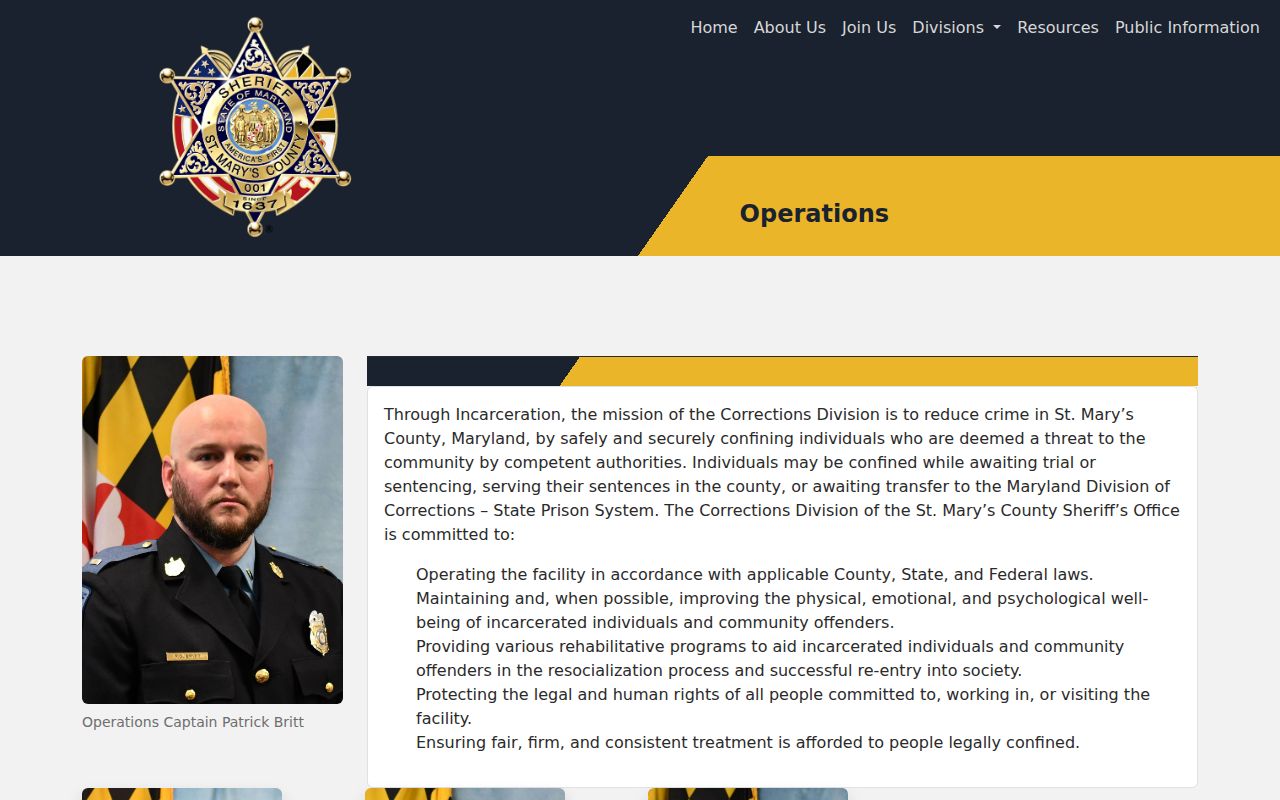
The captured categories explain why a current roster cannot serve as a Community Corrections participant or release list.
Community Corrections Records Contact
The research identifies Community Corrections through the Sheriff’s official program page, but it does not provide a separate public participant search or a distinct street address and phone that can safely be published as a person-status line. Use the official page for program scope. For a public record, the Sheriff’s current NextRequest portal is the documented submission route. For a controlling judicial order, use the proper court file.
23150 Leonard Hall Drive
Leonardtown, MD 20650
301-475-4200 ext. 1900
smcso.opr@stmaryscountymd.gov
Describe the person and the exact existing record sought. Include full name, date of birth, case number, program and date range if known. Ask for segregable portions and electronic delivery. Do not demand that the Sheriff create a new explanation of whether the person is “released.” A precise request may ask whether an existing admission, discharge, violation, or remand record is held and available under applicable law.
District Court is at 23110 Leonard Hall Drive in Leonardtown and handles traffic, misdemeanors, and certain felonies. The listed phone is 301-880-2700, with weekday hours from 8:30 a.m. to 4:30 p.m. except holidays. The Circuit Clerk is at 41605 Courthouse Drive, Leonardtown, with 301-475-7844. Complete-file requests follow court access rules, not the Maryland Public Information Act.
Community Corrections Release Support
The Sheriff’s broader corrections services describe a continuum from community to incarceration and back. At SMCDRC, case managers, a licensed social worker, and peer specialists can work on individual transition plans. Medication continuity and referrals are part of the documented medication for opioid use disorder program. Those services provide local context for a person moving from detention to monitored community status.
They are not universal guarantees. The sources do not state that every Community Corrections participant receives every service, that any service continues for a fixed time, or that a named provider must accept a referral. Verify the person’s own order and plan with the responsible office. Do not treat a program description as proof of current participation or completion.
Parole, probation, and mandatory supervision are also distinct. Probation is a court status. Parole is conditional release decided by the Maryland Parole Commission, while the Division of Parole and Probation supervises parole, probation, and mandatory release. Community Corrections is a Sheriff-operated local alternatives program. One person may pass through more than one system, but the records should not be merged into one label.
Note: Program availability describes local capacity, not a promise of individual placement, release, or continued care.
St. Mary’s Corrections Expansion History
Community Corrections operates within a county system that also expanded its detention and rehabilitation space. A June 2021 ribbon cutting marked clinic and infirmary space, female living units, and rehabilitation program space at SMCDRC. The county later reported that the multi-phase expansion and renovation reached completion in January 2023. The dates describe two stages of one project and should both be preserved.
That history helps explain the Sheriff’s linked detention, treatment, reentry, and community alternatives roles. It does not mean Community Corrections is part of the jail roster, nor does it turn the new program space into a public participant lookup. Current status still depends on the court order, the Sheriff program record, and any later custody event.
Community Corrections Exit Outcomes
A Community Corrections exit can reflect successful completion, a court modification, movement to another supervision status, inpatient treatment changes, or remand. The source must name the event. A completed pretrial program does not decide the criminal case, and a case disposition does not always state when monitoring ended. Obtain the order or agency record tied to the exact change.
If SMCDRC custody follows, the Sheriff’s current lookup may show a new local listing. If Maryland prison follows a state commitment, the DPSCS locator may later show current qualifying placement. If neither system shows a result, the absence remains inconclusive. Check VINE, court records, and the proper custodian rather than assuming discharge.
The St. Mary’s County detention and Community Corrections operations are related but distinct. For an actual jail departure, use the SMCDRC release record route. For the monitored alternatives status, use the court order and Community Corrections records. Naming the exact system prevents the common mistake of equating “outside jail” with “off all control.”
Public Record Search
Sponsored Results