
St. Mary’s Projected Date Gap
Maryland’s public Incarcerated Individual Locator has no projected, tentative, maximum, scheduled, or equivalent release-date field. It is a current-placement locator for qualifying people committed to the Commissioner. DPSCS also states that people no longer in custody for any reason, including release or escape, are not listed. Some short-sentenced people may also be omitted.
This negative finding is the first answer. A no-result cannot be read as release, and a current result cannot supply the date. Maryland does not provide the sort of public date calculator found in some states. An actual calculation must come from SMCDRC for a local sentence or DPSCS for a state commitment. A court sentence supplies crucial inputs, but not necessarily the gate date.
The official DPSCS locator limitation is visible in the source image below.
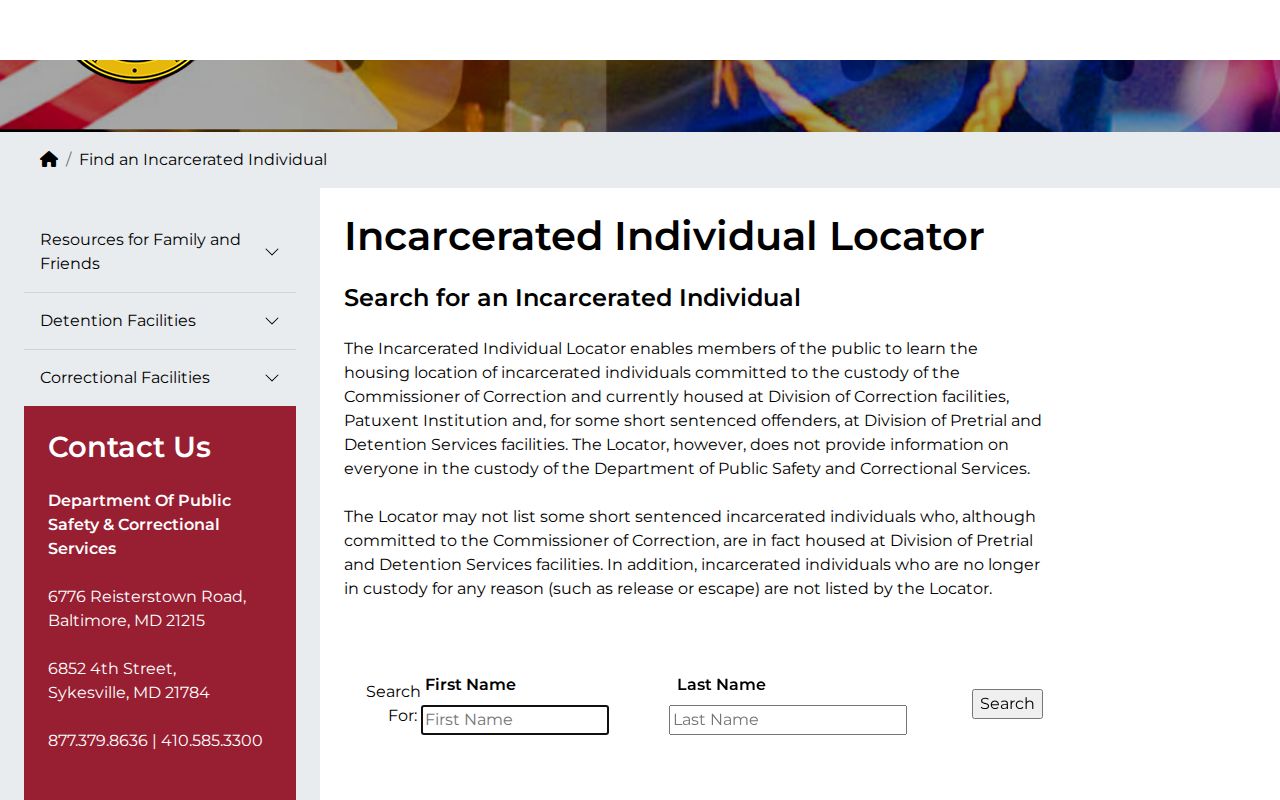
The limitation text prevents a missing name from being turned into a false discharge date.
St. Mary’s Release Date Types
A single sentence can produce several dates with different meanings. Sentence expiration is the judicial term after lawful calculations. Parole eligibility is the first possible point for discretionary consideration, not a right to release. Parole approval is a conditional decision that may still require an approved home plan or program. Mandatory or conditional release occurs when the applicable statute and credit ledger are satisfied, usually with supervision terms. An internal tentative date is an administrative forecast. Actual release is the recorded custody event.
Label the date before comparing it with another source. Booking, bond posting, court order, eligibility, approval, transport, and actual release dates are not interchangeable. A person can have a parole hearing and remain confined. Another may reach a mandatory point but transfer to a detainer. The phrase “release date” is too broad unless the record says which date it means.
- Projected date
- A changeable forecast based on the agency’s current calculation.
- Parole eligibility
- The earliest statutory point for possible parole consideration.
- Mandatory supervision
- Release under written terms when an eligible sentence less credits reaches its statutory point.
- Maximum expiration
- The calculated end of the controlling term, subject to the official record.
- Actual release
- The completed custody event with date, method, and destination.
Find St. Mary’s Projected Release
The search starts with custody type. SMCDRC holds people awaiting trial or sentencing, serving local terms, and waiting for transfer to Maryland DOC. Each group requires a different route. A person awaiting trial may have no fixed departure date. A local sentenced person’s calculation belongs to the county custodian. A state prisoner’s ledger belongs to DPSCS, even if the person was first held in Leonardtown.
- Confirm identity with full name, date of birth, booking or commitment number, case number, and the sentence date.
- Identify whether the controlling custody is county, Maryland DOC, federal, immigration, or another county.
- Obtain the sentencing order, commitment start date, credit for time served, offense and offense date, and whether terms run together or one after another.
- Ask the custodian for the existing sentence calculation, credit ledger, disciplinary adjustments, holds, and the date label it currently uses.
- Check the court for later orders and the correct receiving system for a transfer or detainer.
- Register with Maryland VINE for a reported custody change, then obtain the final release record after the event.
A named-person search across all custody types should start by identifying the custodian. That broader path should support, not replace, the authoritative calculation.
Maryland Credits Change Release Dates
For a Maryland state term, Correctional Services § 3-704 provides an initial good-conduct deduction of ten days per calendar month. The rate is five days when a term includes a concurrent or consecutive crime of violence under the named statute or certain controlled-substance offenses. Partial months are prorated. Credit is unavailable for a stayed sentence, escape or other noncustody time, and a period the Parole Commission disallows after parole revocation.
Section 3-707 authorizes special project and program credits, generally up to twenty days per month. The cap is lower for the restricted offense groups listed in the law. Section 3-708 generally caps combined monthly deductions at twenty days for that restricted group and thirty for others, subject to additional law. Section 3-702 adds exclusions for specified offenses and repeat circumstances.
Credits can be earned, revoked, or restored. The official Maryland diminution-credit synthesis helps explain the framework, but an outside reader lacks the full ledger. The statute is an input, not a do-it-yourself promise.
Note: Offense date, offense class, sentence structure, and the current ledger control; a monthly rate alone cannot establish departure.
St. Mary’s Local Release Credits
Local SMCDRC sentences use Maryland’s local-detention provisions rather than simply copying the state-prison rules. Correctional Services Title 11 addresses presentence and postsentence deductions. Section 11-502 establishes deductions subject to exclusions. The legislative synthesis explains postsentence good conduct as five days per month when the term includes a violent or specified drug offense, and ten days otherwise, with prorating.
Local provisions may also allow presentence credit for disciplinary compliance and work where available, plus qualifying task, education, and program credits. Section 11-507 permits revocation with due process. The Sheriff applies the actual facts to the local record. Someone later transferred to DPSCS may also have jail credit carried into the state computation, but the receiving agency performs the authoritative state calculation.
Ask SMCDRC for an existing calculation or final release record. Do not ask the Sheriff to create a new forecast from incomplete facts. Include the full name, date of birth, booking identifier, commitment period, and the exact date type sought. A narrow record request is more likely to return the ledger or release sheet that already exists.
No St. Mary’s 85 Percent Rule
No universal current Maryland rule requiring every person to serve 85 percent was found. Maryland uses sentence and offense-specific parole thresholds, credit rules, exclusions, and release provisions. A simple percentage can therefore give a false date.
Under Correctional Services § 7-301, many terms of six months or more reach ordinary parole consideration after one-fourth of the aggregate sentence. Violent offenses and certain other terms have different thresholds. For a violent crime committed on or after October 1, 1994, the general threshold is the greater of one-half of the aggregate violent sentence or one-fourth of the total aggregate sentence, plus any no-parole term. Life and repeat-offense provisions vary further.
Eligibility does not compel approval. MPC may refuse, set a rehearing, or approve subject to pre-release needs. Approval can be delayed by a home plan, program placement, or misconduct. The later actual custody event remains the release proof.
What Changes St. Mary’s Release Dates
A projected date reflects the agency’s current set of facts. The table identifies major inputs documented in the Maryland research. None should be guessed from a public locator.
| Change | Possible effect | Best record |
|---|---|---|
| Presentence jail credit | Moves the credited start calculation | Commitment and court order |
| Concurrent or consecutive terms | Changes aggregate sentence length | Sentencing order |
| Credits earned, revoked, or restored | Moves a tentative or mandatory point | Official credit ledger |
| Disciplinary action | May reduce or delay credits or approval | Custodian record |
| Later court order | May alter the sentence or custody authority | Signed order and docket |
| Parole action | Creates eligibility, rehearing, refusal, or conditional approval | MPC record |
| Detainer or transfer | Ends one custody but starts another | Release destination and receiving record |
A detainer is a request or order for another custodian to hold or receive the person. It explains why a correct sending-agency release date may not mean return home. Always read method and destination with the date.
St. Mary’s Mandatory Release Records
Section 7-501 requires conditional release for qualifying DOC terms over eighteen months when the term less allowed credits is reached. Violent offenses committed on or after October 1, 2009 cannot conditionally release before the applicable parole threshold. Section 7-503 requires a written mandatory-supervision order with conditions before release, apart from the stated release-to-detainer situation.
Mandatory supervision is still a sentence status. It can carry reporting and other written terms through the remaining period. That is why the projected custody date, supervision expiration, and discharge date can differ. The St. Mary’s probation and parole record path explains how supervision evidence is checked after institutional release.
After the event, compare VINE’s reported change, the final custodian record, the written supervision order, and any receiving-agency record. The final sheet should identify the actual time, release method, and destination. If the person was transferred, describe the narrow fact: released by one custodian to another.
Request St. Mary’s Date Records
For a local term, direct the request to the St. Mary’s County Sheriff through NextRequest. Ask for existing booking and commitment records, the sentence calculation or credit ledger if held and disclosable, actual release date and time, release code with its key, and destination. The current jail lookup supplies booking context but no projected field, while the Sheriff’s custody categories distinguish local sentences from people awaiting state transfer. For a state term, use the DPSCS Public Information Act process and provide name, date of birth, SID or DOC number, facility, and dates.
Current state placement can be checked by DOC Data Processing at 410-585-3350, 3351, or 3352 with full identity details. That service is not discharge proof and is not a promised sentence-computation line. Ask the record holder whether the quoted date is projected, mandatory-supervision, maximum-expiration, parole-eligibility, or actually scheduled. Register with St. Mary’s VINELink inmate search for the source-reported event.
When a date changes, preserve both versions and the source date rather than treating the older value as false. A restored credit, revoked credit, amended order, new hold, or corrected commitment record may explain the revision. The current custodian can identify the record that controls now. After departure, request the actual release sheet so the forecast is not mistaken for the completed event.
Note: A precise request for an existing calculation avoids asking an agency to create a new date from incomplete information.
Public Record Search
Sponsored Results